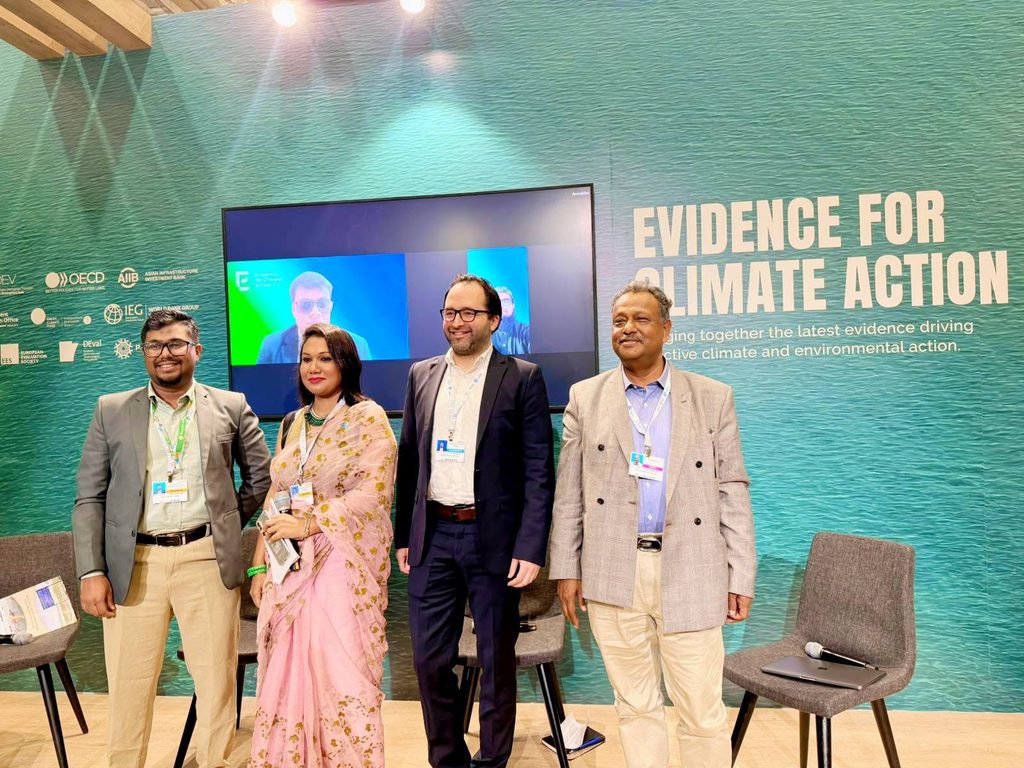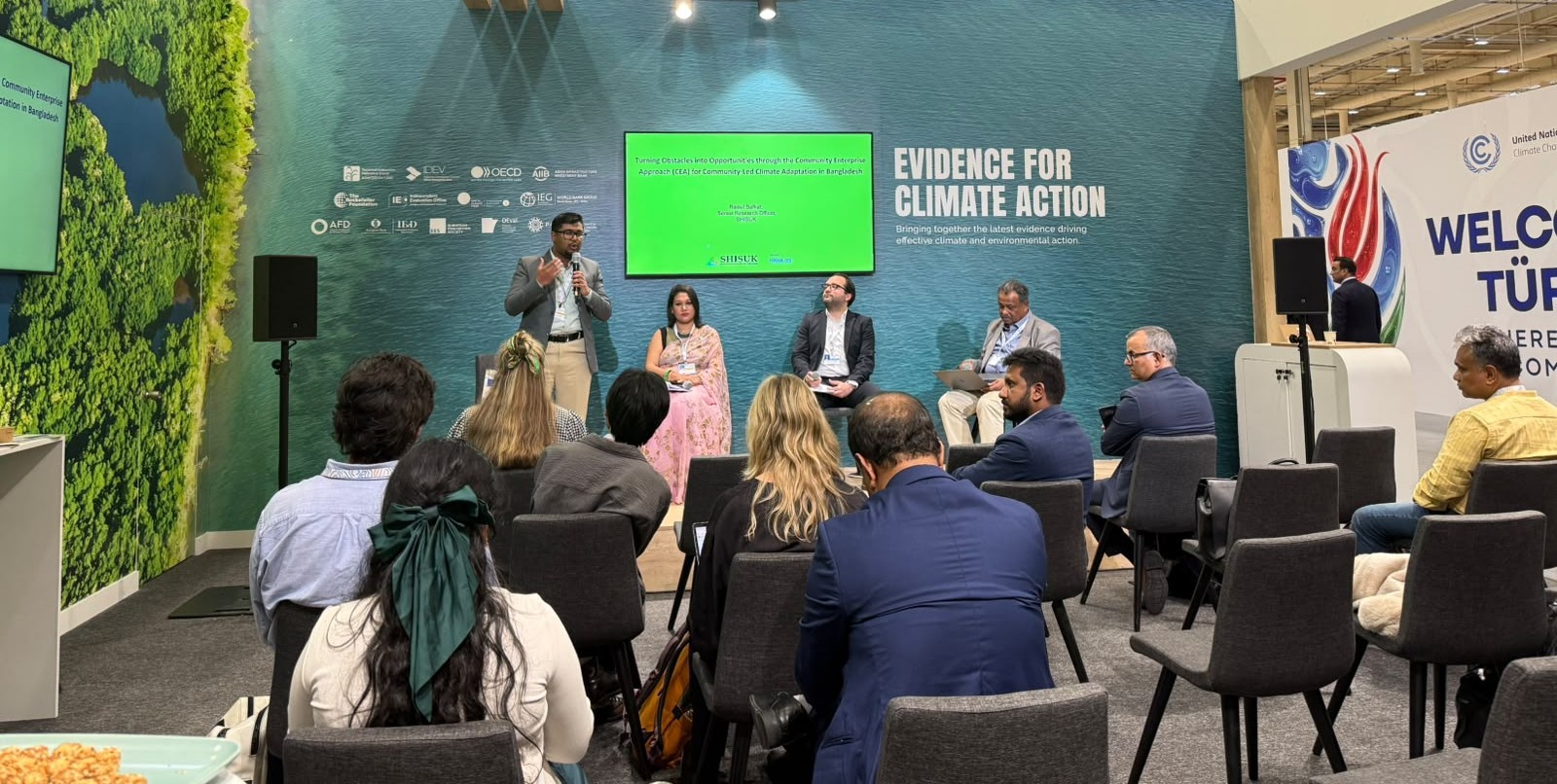
ANTALYA, TÜRKİYE / DHAKA, BANGLADESH — SHISUK (Shikkha Shastha Unnayan Karzakram) presented three decades of grassroots evidence on self-financing, community-owned climate adaptation during the 31st UN Climate Change Conference (COP31) in Antalya, Türkiye. On 14 November 2026, SHISUK Senior Research Officer Raisul Safkat delivered a featured presentation at the Evidence for Climate Action (E4CA) Pavilion (D445) in the COP31 Blue Zone during the high-level session titled “Community-Led Adaptation and Climate Justice”.
Organised by the Eco-Social Development Organization (ESDO) under the E4CA platform, the session was moderated by Dr. Md. Shahid Uz Zaman, Founder and Executive Director of ESDO. The dialogue brought together Bangladeshi researchers, academics, and development practitioners to examine practical pathways for locally led adaptation, featuring presentations alongside Maria Aktar (Project Manager, CAP-RES, ICCCAD, Independent University, Bangladesh), Imrul Kabir (Assistant Professor, Department of Social Work, Jamalpur Science and Technology University), and Md. Noman Amin (Senior Research Officer, Bangladesh Research Institute for Development – BRID).
Moving Beyond Donor Dependency to True Community Ownership
Presenting on the theme “Turning Obstacles into Opportunities through the Community Enterprise Approach (CEA) for Community-Led Climate Adaptation in Bangladesh”, Raisul Safkat addressed one of the most persistent challenges in global climate finance: why externally designed adaptation projects often fail to sustain momentum once donor funding ends.
Challenging the assumption that merely implementing a project within a village automatically creates local ownership, Safkat argued that durable sustainability only emerges when community members hold a direct financial and governance stake in the initiative . Since its founding in 1994, SHISUK has pioneered the Community Enterprise Approach (CEA)—an institutional framework that brings rural communities together to form self-governing enterprises that generate sustainable income while strengthening local climate resilience.
The Power of Collectivisation: Lessons from Daudkandi
To illustrate the mechanics of the Community Enterprise Approach, Safkat shared the story of Daudkandi in Cumilla, Bangladesh, where SHISUK began its foundational work in 1994 . For six months every year during the seasonal monsoon, Daudkandi’s agricultural lands remain deeply inundated. Because floodwaters erase physical boundaries between privately owned plots, no individual farmer could profitably invest in the open water alone, leaving vast tracts choked with water hyacinths and economically idle for half the year.
To demonstrate how collective action overcomes individual resource constraints, Safkat engaged the E4CA Pavilion audience in an interactive exercise [03:20]: while a single person owning one chair in a hall can only use it to sit, twenty individuals pooling their twenty chairs into a collective enterprise can immediately rent the seating out as an event venue and generate revenue .
Applying this principle in Daudkandi, SHISUK mobilised approximately 100 landowners and local stakeholders to pool their seasonally flooded lands into a unified community enterprise for floodplain aquaculture . Through a structured process of community mobilisation, stakeholder engagement, equity shareholding for local capital formation, collective fish stocking, and environmental infrastructure development, the community transformed seasonal flooding from an agricultural crisis into a shared economic asset.
Documented Economic, Ecological, and Gender Outcomes
Drawing on empirical research and satellite-monitored field data, Safkat highlighted how the Daudkandi Community Enterprise model delivers measurable multi-dimensional benefits:
- Self-Sustaining Economic Returns: A single floodplain community enterprise generates at least 60 million BDT (Taka) annually through collective aquaculture, distributing profits directly to community members as share dividends and stimulating backward and forward market linkages across the local economy.
- Agroecological Co-Benefits and Emission Reductions: Collective floodplain management clears invasive water hyacinths and retains fresh water, lowering agricultural input costs and increasing crop yields during the subsequent dry farming season. Integrated with Alternate Wetting and Drying (AWD) practices, the model also contributes to climate mitigation by reducing agricultural methane and nitrogen emissions.
- Shareholder Democracy for Rural Women: Rather than treating women as passive aid beneficiaries, the CEA structure enables rural women to subscribe to equity shares. As formal shareholders, women secure voting power and a permanent seat at the executive decision-making table, directly shaping resource governance and profit distribution.
Watch the Full COP31 Presentation
Watch Raisul Safkat’s complete presentation at the Evidence for Climate Action (E4CA) Pavilion in Antalya, Türkiye:
- YouTube Video Link: https://youtu.be/S6bg_H-ramo?si=TZw_2rNJNdTNzgZc (http://www.youtube.com/watch?v=S6bg_H-ramo)
Advancing Locally Led Climate Justice
SHISUK’s intervention at the E4CA Pavilion underscored that climate justice requires shifting power, capital, and governance directly to frontline communities. By proving that smallholder farmers, landless households, and rural women can co-invest in and govern their own common-pool resources, SHISUK continues to champion scalable, market-viable pathways for community-led adaptation across Bangladesh and the Global South.