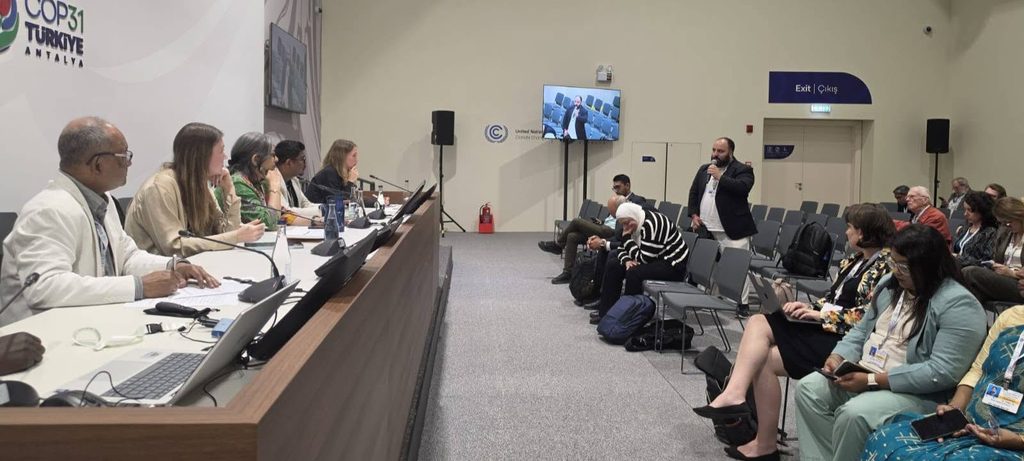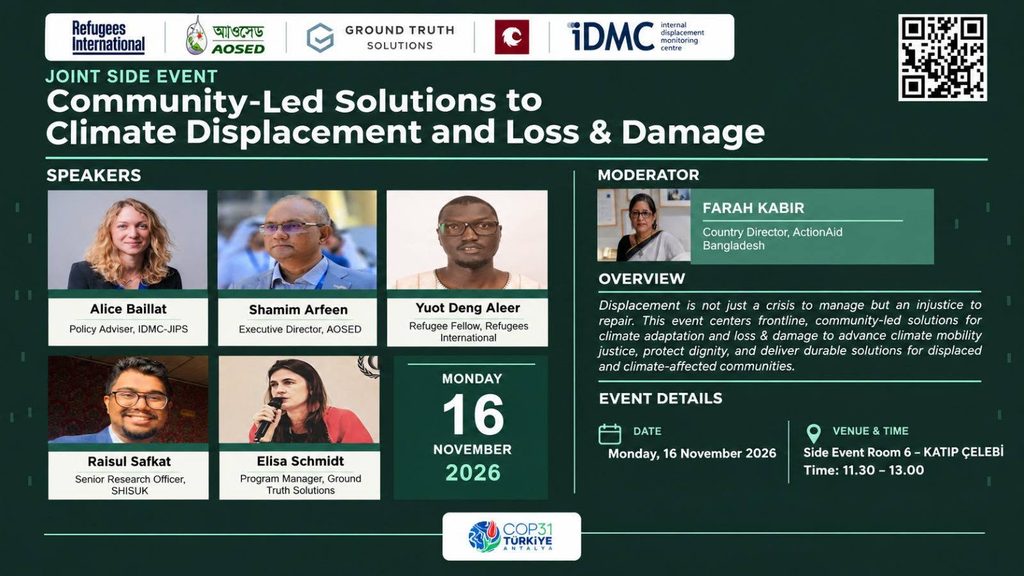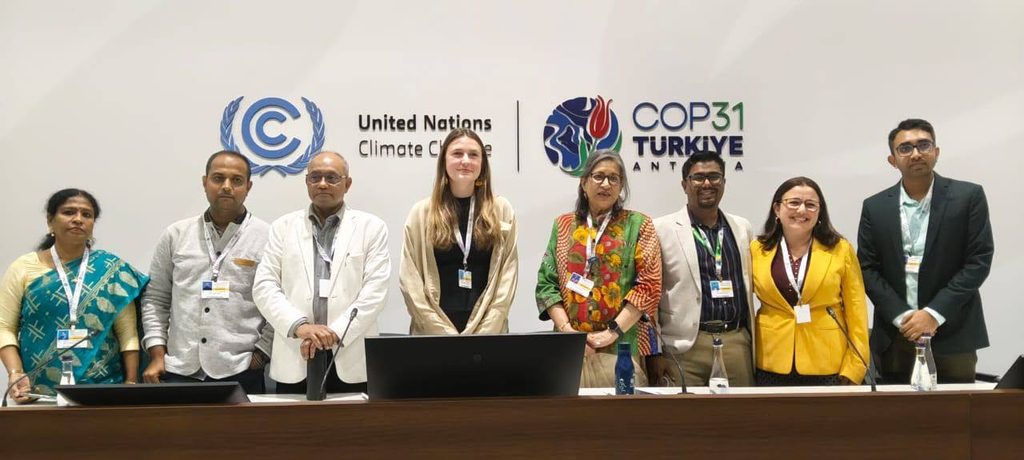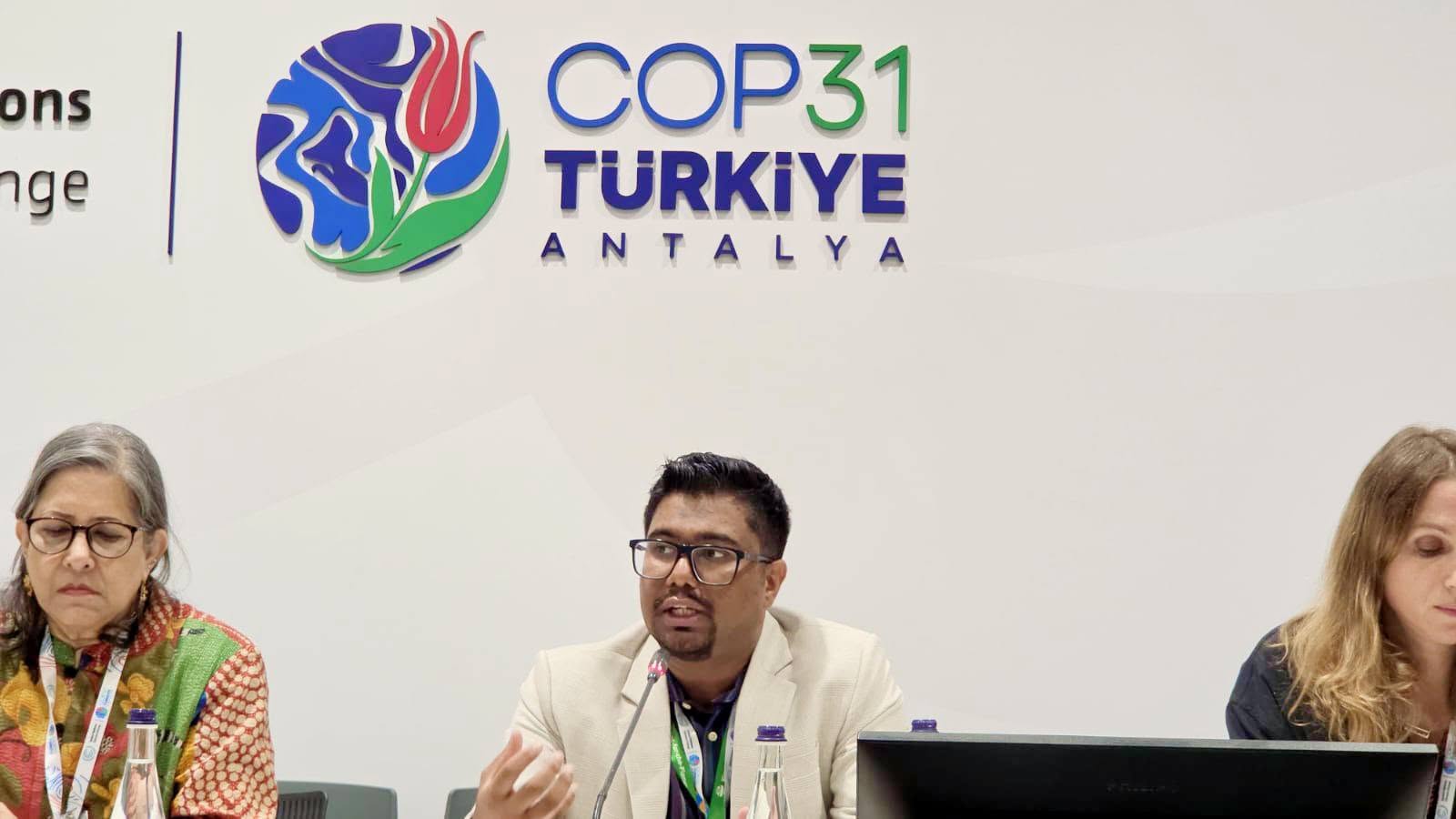
ANTALYA, TÜRKİYE / DHAKA, BANGLADESH — SHISUK (Shikkha Shastha Unnayan Karzakram) contributed grassroots development insights to an official joint side event at the 31st UN Climate Change Conference (COP31) in Antalya, Türkiye. On Monday, 16 November 2026, from 11:30 to 13:00, SHISUK Senior Research Officer Raisul Safkat joined international researchers and practitioners at Side Event Room 6 – Katip Çelebi for the session titled “Community-Led Solutions to Climate Displacement and Loss & Damage”.
Co-organised by Refugees International, AOSED (An Organisation for Socio-Economic Development), Ground Truth Solutions, and the Internal Displacement Monitoring Centre (IDMC), the session examined frontline, community-led strategies to repair the injustices of climate displacement, protect human dignity, and deliver durable solutions for climate-affected populations.
Translating Research into Community-Owned Action
While researchers presented empirical data on climate displacement and loss and damage, the panel placed particular emphasis on translating academic findings into practical, community-level solutions. Representing SHISUK, Raisul Safkat underscored a central lesson from nearly three decades of field implementation in Bangladesh: local natural resources and traditional knowledge do not automatically translate into climate resilience. Instead, they become durable economic and social capital only when communities are organised through formal institutions to mobilise, govern, and collectively benefit from them.
Drawing on SHISUK’s pioneering Community Enterprise Approach (CEA), Safkat structured his intervention around three interconnected dimensions:
- Understanding the Multidimensional Roots of Vulnerability: Climate shocks disrupt livelihoods, food systems, and economic and social security simultaneously. Even when rural households possess valuable traditional knowledge, skills, labour, and natural resources, individual families often lack the capacity to absorb large-scale environmental risks on their own.
- Collective Action as the Missing Institutional Mechanism: The primary barrier facing climate-vulnerable communities is rarely the absence of resources, but rather the lack of institutional mechanisms through which residents can pool assets, share risks, and govern common-pool resources together. Through CEA, communities transform underutilised common-pool resources into community-owned enterprises, generating both monetary returns and non-monetary social ownership.
- Economic Stability as a Pathway to Resilience: Drawing parallels with the Economic Big Push Theory, Safkat explained how coordinated initial investments in community enterprises stimulate local capital formation, strengthen household livelihoods, and trigger a ripple effect of broader socio-economic stability.
Redefining Resilience and Climate Mobility Justice
The discussion also explored the critical intersection between local economic resilience and climate-induced mobility. Safkat noted that climate mobility cannot be addressed solely through emergency disaster management; policymakers must equally address the economic and institutional conditions that determine whether people can remain in place, adapt, or move safely with dignity.
As emphasised during SHISUK’s intervention, genuine community resilience does not mean compelling people to remain in high-risk areas regardless of danger. Rather, it means ensuring that frontline populations possess genuine agency and economic security—so that migration is a dignified choice rather than a forced consequence of livelihood collapse.
Distinguished Panel and Institutional Collaboration
Moderated by Farah Kabir, Country Director of ActionAid Bangladesh, the joint side event brought together diverse perspectives from humanitarian, research, and grassroots organisations:
- Raisul Safkat — Senior Research Officer, SHISUK
- Shamim Arfeen — Executive Director, AOSED
- Alice Baillat — Policy Adviser, IDMC–JIPS
- Yuot Deng Aleer — Refugee Fellow, Refugees International
- Elisa Schmidt — Program Manager, Ground Truth Solutions
Advancing Community Ownership in Global Climate Governance
Since its establishment in 1994, SHISUK has worked across Bangladesh to advance safe migration, community enterprise, agroecology, and inclusive rural governance. By demonstrating how capital formation serves as the starting point, collective action the mechanism, and community resilience the outcome, SHISUK’s contribution at COP31 reinforced a vital message for global climate finance: frontline communities must be recognized not merely as passive aid recipients, but as resource owners, economic actors, and primary decision-makers.