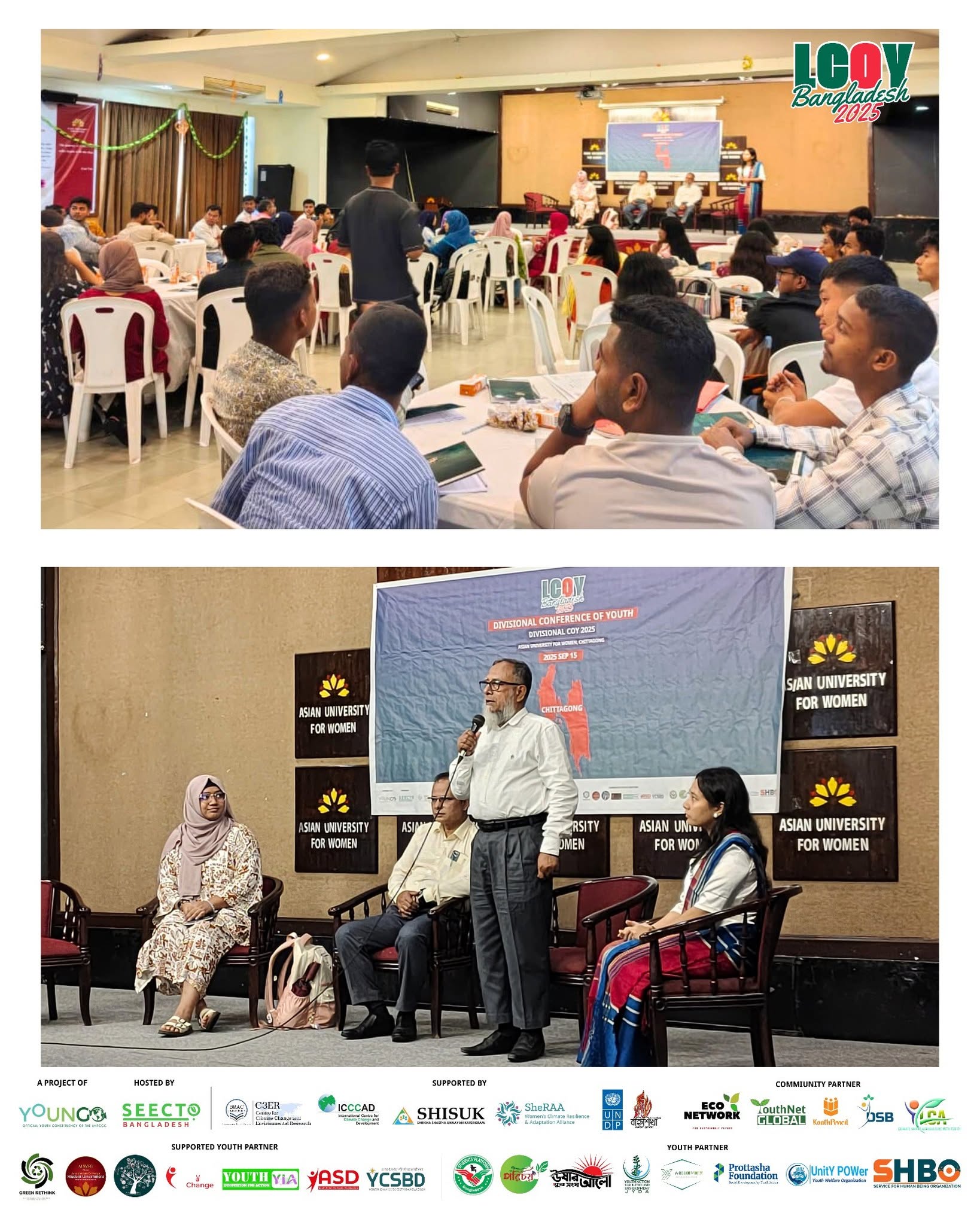
At the Asian University for Women, young changemakers gathered to confront coastal vulnerabilities, landslides, and urban environmental stress, channeling regional priorities directly into Bangladesh’s National Youth Climate Statement 2025.
Chattogram, September 15, 2025 — Young climate advocates, students, and community leaders from across Chattogram Division convened today at the Asian University for Women for the Chattogram Divisional Conference of Youth (COY). Serving as a critical regional milestone on the road to the Local Conference of Youth (LCOY) Bangladesh 2025, the day-long conference provided a dedicated platform for youth to translate their lived experiences into actionable climate policy recommendations.
Confronting Frontline Climate Realities
Chattogram stands at the intersection of Bangladesh’s most acute environmental crises. Throughout the sessions, participants highlighted the compound hazards threatening the division, ranging from accelerating sea-level rise and saltwater intrusion across coastal belts to intensifying tropical cyclones, deadly hill landslides, and mounting urban climate distress.
The conference offered an open forum for young people to share the everyday realities of ecological degradation within their communities. Rather than viewing themselves merely as victims of environmental breakdown, delegates engaged in structured dialogues to explore localized adaptation models, community preparedness, and sustainable urban-rural planning.
Shaping the National Youth Climate Statement 2025
The primary ambition of the Chattogram convening was to build collective ownership over policy solutions. The thematic discussions and working groups held throughout the day directly contributed to the formulation of the National Youth Climate Statement 2025.
By consolidating localized insights from coastal and hilly terrains, the declaration ensures that the specific vulnerabilities of Chattogram are accurately represented in Bangladesh’s high-level climate policy dialogues, as well as on global advocacy stages leading up to international climate negotiations.
Cross-Sector Solidarity and Leadership
The conference featured technical discussions and panel dialogues involving prominent civil society figures and development practitioners. Md. Zillur Rahman, Director of Programs at Shikkha Shastha Unnayan Karzakram (SHISUK), participated as an invited panel guest, engaging with youth representatives and sharing strategic insights on grassroots environmental resilience and community-led adaptation.
The Chattogram Divisional COY is part of the global framework operated under YOUNGO—the Official Children and Youth Constituency of the United Nations Framework Convention on Climate Change (UNFCCC). Hosted in Bangladesh by Seecto Bangladesh, the event was made possible through the unified backing of key institutional partners:
- Shikkha Shastha Unnayan Karzakram (SHISUK)
- United Nations Development Programme (UNDP) in Bangladesh
- International Centre for Climate Change and Development (ICCCAD)
- Centre for Climate Change and Environmental Research (C3ER), BRAC University
- SheRAA Women’s Climate Resilience and Adaptation Alliance
- Youth Empowerment in Climate Action Platform (YECAP)
- Bonhishikha – Unlearn Gender
By uniting young leaders from across diverse ecological zones, the Chattogram Divisional COY affirmed that frontline communities must lead the climate narrative. Through sustained cross-sector alliances, SHISUK and its partners continue to champion youth agency, ensuring that localized lived experiences serve as the foundation for national climate resilience and social justice.